
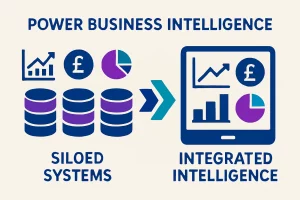
Finance leaders across the UK are under immense pressure. The mandate is clear: accelerate reporting, ensure pinpoint accuracy, and maintain strict compliance, all within increasingly complex financial ecosystems. Yet, many teams are hamstrung by a critical bottleneck—disconnected systems. When your ERP, payroll, banking, and treasury platforms don’t communicate, you’re not just losing efficiency; you’re forfeiting true power business intelligence.
Manual data handoffs between siloed systems create a cascade of errors, delays, and limited visibility. API integration is the essential catalyst that transforms this fragmented data into a strategic asset, automating workflows and empowering the data-driven decisions that define modern financial leadership.
However, achieving this seamless flow requires a strategic approach. This guide provides UK mid-market and enterprise finance leaders with a framework for evaluating, selecting, and implementing API integration solutions that deliver measurable ROI and unlock transformative business intelligence.
Key Considerations for API Integration: Building a Foundation for Intelligence
Selecting the right API solution is about more than just connectivity—it's about building a reliable data foundation for analytics and insight.
1. Enable Seamless System Interoperability
-
Core Compatibility: Confirm native connectors for your essential finance stack (e.g., Sage, Xero, Oracle, SAP, MS Dynamics).
-
Open Banking Ready: Ensure support for UK Open Banking APIs for secure, direct banking data feeds.
-
Pre-built Connectors: Leverage existing connectors to accelerate deployment and reduce custom development costs.
2. Prioritise Robust Security & Regulatory Compliance
-
UK-First Compliance: Verify adherence to UK GDPR, FCA regulations, and, where relevant, HMRC requirements like Making Tax Digital (MTD).
-
Enterprise-Grade Security: Demand strong encryption (TLS 1.3), OAuth 2.0 authentication, and audit trails.
-
Vendor Governance: Assess the vendor’s data residency policies and incident response protocols.
Ensure Performance at Scale
-
Handle Peak Loads: The API must manage month-end and year-end volumes without latency.
-
Flexible Processing: Support for both real-time syncs and scheduled batch processing is crucial.
-
Reliability Guarantees: Scrutinise SLAs for uptime (aim for 99.9%+), support response times, and disaster recovery.
4. Demand Transparent Pricing & Clear ROI
-
Model the Total Cost of Ownership (TCO), including setup, licensing, maintenance, and scaling.
-
Compare pricing models: per-transaction, tiered subscription, or enterprise licence.
5. Evaluate Vendor Support & Ecosystem
-
Review the quality of technical documentation, sandbox environments, and community support.
-
Choose a partner with proven expertise in the UK financial sector and its regulatory landscape.
The Tangible Impact: From Integration to Intelligence
API integration is the engine that powers advanced business intelligence, yielding concrete financial benefits:
| Metric | Typical Improvement |
|---|---|
| Labour Cost Reduction | 25–45% fewer manual processing hours |
| Financial Close Cycle Time | 35–55% faster close |
| Reduction in Accounting Errors | 15–35% fewer discrepancies |
| Cash Flow Forecasting Accuracy | 10–20% improvement in visibility |
Real-World Example: A UK-based distributor integrated its inventory, ERP, and banking platforms via APIs. This created a single source of truth, automating reconciliation, shortening the monthly close by 6 days, and improving cash flow forecasting—generating over £100,000 in annual savings and providing leadership with real-time business intelligence for strategic decisions.
| Category | Vendor/Platform | Best For |
|---|---|---|
| General Automation | Zapier, Make (Integromat) | Rapid, low-code workflow automation between common apps. |
| Enterprise Integration | MuleSoft Anypoint Platform, Boomi | Complex, large-scale finance ecosystems require robust API management. |
| Microsoft-Centric | Microsoft Power Automate (with Power BI) | Organisations deeply invested in the Microsoft stack, seeking seamless Power BI analytics. |
| Accounting Specialists | Sage API Suite, Xero API | Deep, compliant integration with core UK accounting and payroll systems. |
| Open Banking | TrueLayer, Plaid | Secure, direct connectivity to UK banking institutions for real-time data. |
Implementation Roadmap: Your Path to Powered Intelligence
| Phase | Key Activities | Owner |
|---|---|---|
| 1. Discovery & Planning | Map all data sources and handoffs; define KPIs for intelligence and ROI. | Finance + IT |
| 2. Compliance & Security | Conduct a data governance review; finalise security protocols. | IT Security + Legal |
| 3. Vendor Selection | Shortlist vendors using the criteria above; run proof-of-concept tests. | Procurement + IT |
| 4. Develop & Test | Configure and test integrations in a sandbox; validate data accuracy for reporting. | IT + Finance |
| 5. Train & Adopt | Train teams on new workflows and dashboards; highlight BI benefits. | HR + Change Mgmt. |
| 6. Deploy & Monitor | Go-live; monitor API performance and data pipeline health. | IT |
| 7. Optimise & Scale | Review analytics output and ROI; identify new systems to integrate. | Finance + IT |
References:
-
Microsoft Power Platform Security, https://learn.microsoft.com/en-us/power-platform/admin/security
-
AWS API Gateway FAQs, https://aws.amazon.com/api-gateway/faqs/
-
Google Cloud Apigee Documentation, https://cloud.google.com/apigee/docs/api-platform/features
-
Sage Business Cloud, https://www.sage.com/en-gb/products/sage-business-cloud/