

The Challenge: When Disconnected Systems Cripple Financial Agility
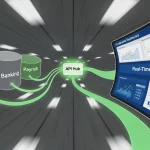
Across the UK finance sector, legacy systems and disconnected applications are silently eroding efficiency. ERPs, banking portals, payroll systems, and compliance tools often operate in isolation, forcing finance teams into a cycle of manual exports, spreadsheet reconciliation, and delayed reporting. This fragmentation doesn't just slow down processes—it increases error rates, obscures cash visibility, and strains regulatory compliance.
Strategic API integration offers a direct path out of this chaos. By creating persistent, secure connections between disparate systems, finance leaders can automate data flows, establish a single source of truth, and redirect their teams from data entry to strategic analysis.
5 Critical Criteria for Selecting Your API Integration Solution
To avoid costly missteps, UK finance leaders must evaluate integration platforms against a stringent, business-aligned framework.
1. Breadth of Connectivity & Ecosystem Fit
-
Does the solution offer native, well-maintained connectors for your core systems (Sage, Xero, Oracle, SAP)?
-
Can it bridge modern cloud applications with legacy on-premise infrastructure?
-
Does it support secure connections to major UK banking networks via Open Banking APIs?
Security Architecture & UK Regulatory Alignment
-
Is the platform architected specifically for GDPR and FCA compliance requirements?
-
Are authentication protocols (OAuth 2.0, OpenID Connect) and encryption (TLS 1.3) non-negotiable defaults?
-
Does it provide immutable audit trails for full regulatory traceability?
3. Performance Engineering & True Scalability
-
Can the integration layer sustain peak transaction volumes—such as month-end close or high-volume billing cycles—without latency?
-
Is the platform built to scale horizontally as your data volume and system complexity grow?
-
What specific uptime guarantees (99.9%+) and latency thresholds are contractually backed by SLA?
4. Vendor Partnership & UK-Grounded Support
-
Is dedicated UK-based technical support available during local business hours?
-
Does the vendor publish transparent SLAs for incident response and resolution?
-
Are implementation resources, certified consultants, and ongoing training included or readily accessible?
5. Total Cost of Ownership (TCO) Clarity
-
Is the pricing model consumption-based, subscription-based, or enterprise-wide?
-
What are the true costs of implementation, custom mapping, and ongoing maintenance?
-
Are there hidden dependencies—such as required middleware or additional security tooling?
5 Common API Integration Pitfalls (And How to Avoid Them)
1. Underestimating Legacy Complexity
Pitfall: Older systems often lack modern RESTful APIs, which can require expensive custom connectors.
Solution: Prioritise platforms with proven legacy adapters or consider API wrappers to modernise interfaces.
2. Treating Security as an Afterthought
Pitfall: Exposed endpoints, weak authentication, or unencrypted data in transit.
Solution: Embed security reviews into every stage; mandate OAuth 2.0 and end-to-end encryption.
3. Unchecked Vendor Lock-In
Pitfall: Proprietary connectors and data formats make switching providers prohibitively expensive.
Solution: Favour platforms that embrace open standards and provide clear data portability policies.
4. Underfunding Change Management
Pitfall: Deploying the technology without winning user buy-in, leading to shadow workarounds.
Solution: Involve finance end-users early, communicate tangible benefits, and invest in role-based training.
5. Neglecting Post-Deployment Governance
Pitfall: Assuming integration is "set and forget."
Solution: Establish ongoing monitoring, version management, and quarterly business reviews with vendors.
Real-World Impact: API Integration Success Across UK Finance
Manufacturing
A Midlands-based manufacturer deployed API integration to connect its legacy ERP with high-street banking APIs. The result? Daily bank reconciliation dropped from 3 hours to 15 minutes, manual journal entries fell by 40%, and the finance team regained six working days per month.
Financial Services
A London-based asset manager integrated its CRM, portfolio accounting system, and FCA reporting engine. Compliance report generation collapsed from five days to under four hours, while real-time data visibility reduced regulatory filing risks.
Retail
A national retail chain unified its EPOS, inventory, and finance systems via APIs. Cash flow forecasting accuracy improved by 25%, and out-of-stock incidents fell by 18% through automated inventory replenishment triggers.
An 8-Step Implementation Roadmap for UK Finance Leaders
| Phase | Focus Area | Key Deliverables |
|---|---|---|
| 1 | Strategic Definition | Document pain points; define KPIs (e.g., close time, error rates, FTEs repurposed) |
| 2 | Discovery & Mapping | Catalogue all systems, data fields, and integration touchpoints |
| 3 | Vendor Selection | Evaluate against the 5 criteria; shortlist; conduct technical proof-of-concept |
| 4 | Security & Compliance Review | Perform Data Protection Impact Assessment (DPIA); validate FCA/GDPR alignment |
| 5 | Iterative Build & Test | Pilot with one high-value workflow; sandbox testing with production-like data |
| 6 | User Enablement | Role-based training; process documentation; establish power-user network |
| 7 | Controlled Go-Live | Phased rollout; hyper-care support; real-time performance monitoring |
| 8 | Continuous Optimisation | Monthly ROI reviews; API version upgrades; expand to new use cases |
Conclusion: From Fragmentation to Fluidity
For UK finance teams, the gap between operational chaos and strategic clarity is bridged by intelligent API integration. By selecting solutions that prioritise security, scalability, and UK-specific compliance, finance leaders can dismantle data silos, reclaim thousands of hours, and build a finance function equipped for the next decade of digital change.
Next step: Identify one manual, high-volume process in your organisation and map how API integration could automate it end-to-end. That single pilot will deliver the evidence needed to scale.