
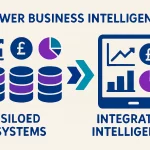

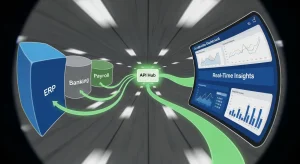
Finance leaders across the UK face mounting pressure: accelerate reporting, enhance accuracy, and maintain compliance within increasingly complex financial ecosystems. The root cause of this pressure is often disconnected systems. Traditional, siloed platforms for ERP, payroll, banking, and treasury create critical bottlenecks, manual errors, and delayed insights. API integration emerges as the essential solution—the technical backbone that
creates seamless data flows, automates processes, and empowers truly data-driven decisions.
However, successfully deploying API integration requires more than just technology; it requires a tailored strategy that aligns financial objectives with IT execution. This definitive guide provides UK mid-market and enterprise finance leaders with a comprehensive framework for evaluating, procuring, and implementing API solutions that deliver measurable, rapid ROI.
Core Considerations for Selecting an API Integration Solution
A strategic approach begins with clear evaluation criteria. Before engaging vendors, finance and IT should align on these five pillars:
1. Seamless System Interoperability
-
Confirm Core Compatibility: Ensure native support for your essential finance stack (e.g., Sage, Xero, Oracle, SAP, MS Dynamics).
-
Verify Open Banking Capability: For UK teams, support for UK Open Banking APIs is non-negotiable for secure, direct banking connectivity.
-
Leverage Pre-built Connectors: Accelerate time-to-value and reduce cost by evaluating the library of existing connectors for your key applications.
2. Robust Security & Regulatory Alignment
-
Ensure UK-Specific Compliance: The solution must adhere to UK GDPR, FCA regulations, and HMRC standards like Making Tax Digital (MTD).
-
Demand Enterprise-Grade Security: Look for strong encryption (TLS 1.3+), OAuth 2.0 authentication, multi-factor authentication (MFA), and detailed audit logs.
-
Assess Vendor Governance: Review the provider’s data residency policies, breach notification procedures, and overall security posture.
3. Guaranteed Performance, Scalability & Reliability
-
Validate Peak Load Capacity: The API integration must handle month-end and year-end transaction volumes without performance degradation.
-
Check Processing Flexibility: It should support both real-time syncs for critical data and scheduled batch processing for efficiency.
-
Scrutinise Service Level Agreements (SLAs): Require clear guarantees on uptime (target 99.9%+), latency, and technical support responsiveness.
Transparent Pricing & Total Cost of Ownership (TCO)
-
Understand the Pricing Model: Model costs for per-API-call, tiered subscription, or enterprise licensing.
-
Forecast the Full TCO: Include all costs: initial setup, customisation, ongoing licensing/support, and scaling for future growth.
5. Comprehensive Vendor Support & Developer Experience
-
Evaluate Documentation & Tools: High-quality API documentation, SDKs, and sandbox environments are critical for efficient development and testing.
-
Confirm Support Structure: Ensure access to timely, knowledgeable technical support with clear escalation paths.
-
Prioritise Sector Experience: Choose a partner with proven expertise in the UK financial services sector and its unique regulatory landscape.
The Tangible Impact of API Integration
Strategic API integration directly translates to improved financial performance and operational control.
| Key Performance Indicator | Typical Improvement via API Integration |
|---|---|
| Reduction in Manual Labour Costs | 25–45% fewer processing hours |
| Acceleration of Financial Close | 35–55% faster cycle time |
| Decrease in Accounting Errors | 15–35% reduction in discrepancies |
| Improvement in Cash Flow Visibility | 10–20% better forecasting accuracy |
Case in Point: A UK wholesale distributor implemented API integration between its inventory system, ERP, and banking platforms. This eliminated manual reconciliation, shortened the monthly close by 6 days, and dramatically improved cash flow forecasting—resulting in annual savings exceeding £100,000 and providing leadership with real-time financial insights.
Recommended API Integration Platforms for UK Finance
| Category | Platform | Ideal Use Case |
|---|---|---|
| Low-Code/General Automation | Zapier, Make (Integromat) | Rapid, business-led automation between common SaaS applications (e.g., CRM to accounting). |
| Enterprise Integration Platform (iPaaS) | MuleSoft Anypoint Platform, Boomi, Workato | Complex, large-scale finance ecosystems requiring robust API management, governance, and transformation. |
| Microsoft Ecosystem | Microsoft Power Automate | Organisations deeply invested in the Microsoft stack (Dynamics, Power BI) seeking seamless workflow automation. |
| Accounting & Payroll Specialists | Sage API Suite, Xero API | Deep, compliant integration with core UK accounting, payroll, and HMRC-facing systems. |
| Open Banking Specialists | TrueLayer, Plaid | Secure, standardised connectivity to UK banking institutions for real-time transaction data and payment initiation. |
Decision Guide: Custom-built integrations offer ultimate flexibility but come with higher long-term maintenance costs. Off-the-shelf platforms provide faster deployment and reliability but may require adapting certain processes to fit available connectors.
Implementation Roadmap: A Phased Approach to Success
| Phase | Key Activities | Primary Owner |
|---|---|---|
| 1. Discovery & Planning | Map all data sources, flows, and pain points; define specific integration goals and KPIs. | Finance + IT Leadership |
| 2. Security & Compliance Review | Conduct a full data governance and risk assessment; finalise security protocols. | IT Security + Legal/Compliance |
| 3. Vendor Evaluation & Selection | Shortlist vendors using the criteria above; run proof-of-concept (PoC) tests. | Procurement + IT |
| 4. Development & Rigorous Testing | Configure integrations in a sandbox; perform end-to-end testing with real data scenarios. | IT + Finance Analysts |
| 5. Change Management & Training | Train end-users on new workflows; communicate benefits to drive adoption. | HR + Change Management |
| 6. Go-Live & Performance Monitoring | Phased deployment; monitor system health, data accuracy, and API performance. | IT Operations |
| 7. Review, Optimise & Scale | Measure ROI against KPIs; gather user feedback; plan next-phase integrations. | Finance + IT Strategy |
References & Further Reading:
-
Microsoft Power Platform Security, https://learn.microsoft.com/en-us/power-platform/admin/security
-
AWS API Gateway FAQs, https://aws.amazon.com/api-gateway/faqs/
-
Google Cloud Apigee Documentation, https://cloud.google.com/apigee/docs/api-platform/features
-
Sage Business Cloud, https://www.sage.com/en-gb/products/sage-business-cloud/