

AI CRM Data Matching Enters RevOps
RevOps has quietly become the function absorbing most of the new AI tooling touching go-to-market data. Forecasting, lead scoring, enrichment, and CRM hygiene have all seen AI-driven tools enter over the past few years, and CRM data matching is where the shift is easiest to see, because the limitations of the old approach were already well known.
Here is what is actually changing, why it is happening in RevOps specifically, and where AI still needs a human in the loop.
Why RevOps Is Where AI Adoption Is Concentrated
RevOps sits at the intersection of sales, marketing, and customer success data, which means it inherits data quality problems from every direction — form submissions, imports, integrations, and manual entry from multiple teams, all landing in the same CRM. That combination of volume and inconsistency is exactly the kind of problem rule-based tools were never well suited to.
It is also a function under constant pressure to prove operational efficiency. A RevOps team that can show a measurable reduction in manual data cleanup hours, or a measurable improvement in forecast reliability, has a clear business case for adopting new tooling. AI-driven data tools deliver on both.
From Manual Rules to AI CRM Data Matching
Traditional CRM deduplication tools, including the native tools built into HubSpot and Pipedrive, rely on rule-based logic: if two records share an exact email address, flag them as a duplicate. This works for the obvious cases and misses almost everything else, because it requires someone to have already anticipated and configured a rule for every pattern duplicates might take.
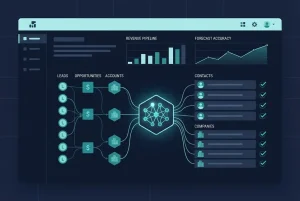
AI CRM data matching works differently. Instead of checking one field at a time against a fixed rule, it evaluates several signals together — name similarity, company, LinkedIn URL, mobile number, email — and calculates the probability that two records represent the same person or company. A contact with an email on one record and only a LinkedIn URL on the other, which no rule-based tool will ever connect, gets caught because the AI model reasons about the combination of signals rather than requiring an exact match on any single one.
This is the same underlying shift fuzzy matching represents at a technical level, now operating at the scale of a full CRM database rather than a single field comparison.
Where AI Is Already Changing CRM Data Management
Deduplication is the most visible use case, but AI CRM data matching is part of a broader shift across CRM data management:
- Data quality scoring — AI models assess completeness and reliability across a full record set, rather than requiring a manual audit
- Missing data detection — incomplete contact and company records get flagged automatically based on what a complete record typically looks like
- Job title standardisation — free-text job titles get grouped into consistent categories without a manually maintained mapping table
- ICP and compliance checks — records get evaluated against ideal customer profile criteria or retention rules at scale, rather than spot-checked
The common thread is that all of these previously required either manual review or a rules engine that someone had to build and maintain. AI CRM data matching and the broader category of AI data quality tools move that work from configuration to inference.
What AI Doesn't Replace: Human Review
None of this means CRM changes should happen without oversight. AI matching produces confidence-scored suggestions, not automatic decisions. A high-confidence match between two contact records is still a suggestion until a person confirms that merging them will not combine two different people who happen to share a name and work at the same company.
This is a deliberate design choice, not a current limitation of the technology. RevOps teams adopting AI CRM data matching are not removing human judgment from the process — they are removing the manual search work that used to precede it, so the human review step focuses only on genuine edge cases instead of scanning an entire database by hand.
What This Means for RevOps Teams Today
Teams still relying on native CRM deduplication or manually configured rule-based tools are, in practice, running on a matching approach that structurally cannot catch a large share of real-world duplicates — not because the tool is poorly built, but because rule-based logic was never designed to reason across multiple fields at once. As databases grow and pull data from more sources, that gap widens rather than closes on its own.
How EazyMatch AI Fits This Shift
EazyMatch AI applies AI CRM data matching directly to HubSpot and Pipedrive, evaluating email address, similar name within the same company, partial name match, LinkedIn URL, and mobile number for contacts, and LinkedIn company URL and website domain for companies — without requiring any matching rules to be configured first.
Beyond matching, it scores overall data quality, flags missing fields, standardises job titles, checks records against ICP criteria, and applies GDPR and retention flags. Every suggestion goes through a review queue, and nothing changes in your CRM until you approve it.
Step 1: Connect your CRM
Step 2: Run checks across contacts and companies
Step 3: Review the queue, ranked by confidence
Step 4: Approve updates — nothing is automatic
Try EazyMatch AI free →
See what AI CRM data matching surfaces in your own database. No credit card required.
FAQ
Q: Is AI CRM data matching accurate enough to trust without review?
A: It is accurate enough to prioritise review effort — flagging high-confidence matches for quick approval and lower-confidence ones for closer inspection — but a human review step remains standard practice before any CRM change is applied.
Q: Does adopting AI data matching require RevOps teams to change their existing workflows significantly?
A: Minimally. The tool connects to your existing CRM and produces a review queue, which slots into the same merge-review process teams already use, just with far fewer duplicates going undetected.
Q: Where should a RevOps team start if they want to see what this looks like on their own data?
A: Running a single scan on an existing HubSpot or Pipedrive portal is the fastest way to see the gap between rule-based and AI-based matching directly, using your own database rather than a hypothetical example.
The Shift Is Already Underway
AI CRM data matching is not a future capability RevOps teams are waiting for — it is already replacing rule-based deduplication in teams that have made the switch, and the gap between the two approaches only grows as CRM databases scale. The teams evaluating this now are deciding how much longer to keep running on matching logic that was never built to handle a multi-source database.
Try EazyMatch AI free →
Connect your CRM and see the difference in a few minutes.