

CRM Data Quality Starts With Governance
Who owns the data in your CRM? Ask that in a pipeline review and you'll probably get three answers. Marketing points at sales ops. Sales ops points at whoever set up the last integration. Sales points at marketing, because "that's where the bad leads come from."
All three are partly right, which is exactly the problem. When everyone touches the data and nobody owns it, CRM data quality becomes everyone's problem and nobody's job. It doesn't collapse overnight. It erodes with every import, every form fill and every rep who creates a new contact rather than searching for the existing one.
Governance is how RevOps fixes that. Not a 40-page policy nobody reads, but a short set of owners, rules and checks that decide how data enters the CRM, how it changes, and when it leaves.
What CRM Data Governance Actually Means
It helps to separate two ideas that often get blurred together:
- Data quality is the outcome: records that are unique, complete, accurate, consistent and current. For a full breakdown, see what CRM data quality is and why it matters for revenue.
- Data governance is the system that produces that outcome: who is accountable, what the standards are, how they're enforced and how you know they're working.
Most teams invest in the outcome directly, through cleanup projects, and skip the system. That's why the results don't last.
Why CRM Data Quality Fails Without Governance
The cost of getting this wrong is well documented. Gartner estimates poor data quality costs organisations an average of $12.9 million per year ("How to Improve Your Data Quality," Gartner, 2021). But the root causes inside a CRM are usually organisational, not technical:
- Too many entry points. Forms, list imports, enrichment tools, integrations and manual entry all create records, and each follows its own rules (or none).
- No shared definitions. What counts as a duplicate? Which record wins in a merge? What makes a contact "complete"? If nobody has written it down, every person answers differently.
- No named owner. Problems get noticed, mentioned in Slack, and left for someone else.
- No measurement. Without a recurring score, nobody can say whether things are improving or getting worse. See why CRM data becomes inaccurate for how quickly unmonitored records drift.
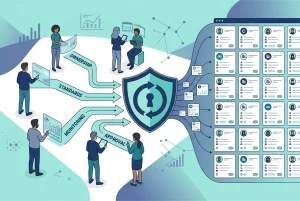
The Five Pillars of a CRM Data Governance Framework
A workable framework for a RevOps team fits on one page. It needs five things.
1. Ownership
Give every core object a named owner. A common split: marketing ops owns contacts from inbound sources, sales ops owns companies and deals, and RevOps acts as steward across all of them, setting standards and arbitrating disputes. The point isn't the exact split. It's that every record type has someone accountable when it goes wrong.
2. Standards
Write down the rules that everyone currently holds in their heads:
- Required fields for a contact, company and deal to count as complete
- Approved values for fields that drive segmentation, such as job title, industry and lifecycle stage
- What counts as a duplicate, and which record becomes the master in a merge
The duplicate definition matters more than most teams expect. If your standard only says "same email address," you've quietly accepted a whole class of duplicates. A contact who exists once with an email but no LinkedIn URL, and again with a LinkedIn URL but no email, is the same person. Your definition should say so, even though HubSpot and Pipedrive native tools won't catch it, because they only match on exact email.
3. Entry controls
Most bad data enters through a handful of doors. Map every source that creates records and put a control on each one: required fields on forms, a pre-import check on every list, and clear rules for integrations. The detail is covered in how to prevent duplicates entering HubSpot.
4. Monitoring
Governance without measurement is just a document. Track a data quality score across uniqueness, completeness and consistency on a fixed cadence, and report the trend alongside pipeline metrics. For how to set your baseline, see CRM data quality benchmarks.
5. Change control and compliance
Decide who can merge, bulk edit and delete, and make sure significant changes are reviewed before they happen. This protects activity history and gives you an audit trail. It also supports your compliance obligations: GDPR requires personal data to be kept accurate (Article 5(1)(d)) and kept no longer than necessary (Article 5(1)(e)). A governance framework should flag records that breach either principle and route them to a person to decide.
A 90-Day Rollout for RevOps
You don't need to govern everything at once. A phased rollout keeps momentum without stalling day-to-day work.
- Days 1 to 30: baseline and owners. Measure your current CRM data quality, count duplicates across contacts and companies, and name an owner for each object.
- Days 31 to 60: standards and entry controls. Document required fields, approved values and your duplicate definition. Close the biggest entry points first, usually imports and forms.
- Days 61 to 90: monitoring and review. Set a recurring check, a review queue for suggested fixes, and a monthly slot to report the score. If you want the checks to run without manual effort, see automating CRM data quality for RevOps.
Where Governance Needs the Right Tooling
This is where many governance efforts stall. The policy says "one record per person," but the tools can't enforce it. Native duplicate management in HubSpot and Pipedrive relies on exact matches, so the email-only and LinkedIn-only records from earlier sit side by side indefinitely, technically in breach of your standard and invisible to every report.
Good governance needs two things from its tooling: detection that matches your actual definitions, not just exact email, and a review step that matches your change control rules, so nothing is merged or deleted without approval.
How EazyMatch AI Puts Governance Into Practice
EazyMatch AI connects to HubSpot or Pipedrive and maps directly onto the framework above:
- Standards, enforced: multi-field AI matching for contacts across email address, similar name within the same company, partial name match, LinkedIn URL and mobile number, and for companies across LinkedIn company URL and website domain. The email-only and LinkedIn-only duplicate gets caught.
- Consistent values: job title standardisation and ICP checks keep segmentation fields usable.
- Monitoring: a data quality score plus missing data detection for incomplete contacts and companies.
- Compliance: GDPR and data retention flags for records past your retention window.
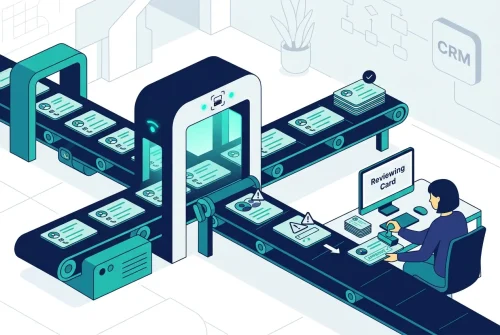
- Change control: every suggestion goes to a review queue. Nothing syncs back to the CRM until a person approves it.
Step 1: Connect your CRM (HubSpot or Pipedrive)
Step 2: Run checks
Step 3: Review suggestions
Step 4: Approve updates - changes only reach your CRM after human approval
Try EazyMatch AI free →
Get your baseline CRM data quality score before you write a single policy.
FAQ
Q: Who should own CRM data governance?
A: RevOps is usually best placed to own the framework, with named owners for each object in marketing ops and sales ops. What matters most is that accountability is explicit.
Q: Is CRM data governance only for large companies?
A: No. A small team needs a lighter version, but the same basics apply: an owner, a written duplicate definition, controls on imports and forms, and a recurring check.
Q: How does governance relate to GDPR?
A: GDPR's accuracy and storage limitation principles (Article 5(1)(d) and (e)) put obligations on how personal data is maintained and retained. Governance gives you the process to meet them, and a retention flag makes breaches visible.
Make CRM Data Quality Someone's Job
Cleanups fix records. Governance fixes the reasons records go bad. Name the owners, write the standards down, control the entry points, measure the score and review every change. Do that, and CRM data quality stops being a quarterly firefight and becomes something the whole revenue team can rely on.
Want a second pair of eyes on your governance framework?