
Inaccurate CRM Data: The Real Causes
Ask most sales or RevOps leaders how clean their CRM is, and the answer is usually framed around duplicates: "we ran a merge last quarter, we're fine." But duplicates are only one symptom. A much larger share of the problem is records that exist once, look complete, and are simply wrong — a job title from two roles ago, an email that quietly started bouncing, a company name that changed in an acquisition nobody updated in the CRM.
Put a number on it and the industry estimates converge in a similar place. Data-decay research going back to SiriusDecisions has put B2B contact data decay at roughly 2% a month, which compounds to somewhere in the 25 to 30 percent range annually — before entry errors and unreconciled duplicates are counted at all. For a database that isn't actively maintained, a third of it being wrong within a year is a realistic, not alarmist, estimate.
The Real Cost of Inaccurate CRM Data
Inaccurate CRM data doesn't fail loudly. It fails quietly, in ways that only show up once you're already relying on the number it produced. A sales rep calls a contact who left the company eight months ago. A campaign gets sent to a job title that no longer exists at that account. An ICP score gets calculated off a company size field nobody's touched since the record was created. None of this trips an error message — the CRM has no way to know the data is wrong, only that a field is filled in. For the fuller breakdown of what this actually costs a sales and marketing org, see the real cost of bad CRM data.
Where Inaccurate CRM Data Comes From
A handful of sources account for most of it:
- Job changes — people change roles and companies constantly, and nothing in a standard CRM setup detects that automatically
- Manual entry errors — a rep typing a phone number or company name by hand introduces small errors that never get caught because they don't look obviously wrong
- Abandoned or partial form fills — a lead fills in a name and email, then bounces before completing the rest, leaving a record that's accurate as far as it goes but too thin to be useful
- Unreconciled duplicates — when the same person exists twice, at least one version is out of date by definition, and most teams never notice because nothing flags the conflict
- Integration sync errors — a marketing automation platform, a form tool, and the CRM all holding a slightly different version of the same field, with no single source of truth
None of these require negligence. They're the predictable result of a database that grows through dozens of entry points, none of which check against what's already there.
What Inaccurate CRM Data Looks Like in Practice
Here's the case that a routine duplicate check won't catch, because on paper there's only one record:
Contact record, created 14 months ago
Name: Priya Nair — Title: Marketing Manager — Company: Solent Digital — Email: [email protected]
What's actually true today
Priya was promoted to Head of Marketing nine months ago, and Solent Digital rebranded to Solent Group six months ago. Her email still routes, so nothing bounces and nothing forces a review. The record looks complete and passes every basic validation check. It's also wrong on two fields that directly feed segmentation, lead scoring, and outreach personalisation.
A second record for the same person, created after a recent conference and never merged, actually has the correct title and company — but no email, so nothing links the two. This is the pattern that keeps inaccurate CRM data hiding in plain sight: the current information exists somewhere in the database, just not reconciled with the record everyone is actually working from.
How EazyMatch AI Catches What Manual Review Misses
EazyMatch AI connects to HubSpot or Pipedrive and runs multi-field AI matching across your contact and company database — email address, name similarity within the same company, partial name match, LinkedIn URL, and mobile number. That's what surfaces cases like Priya's: two records for the same person, one stale and one current, with no shared field for a rules-based tool to link them on.
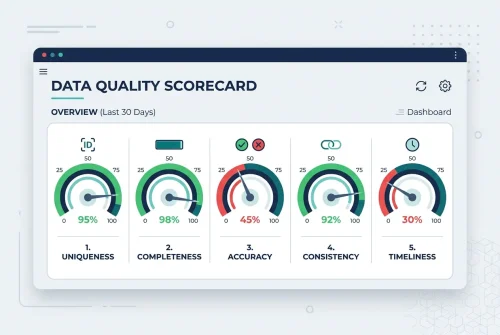
It also scores overall data quality, flags incomplete records, and standardises job title formatting, so the gaps that come from partial fills and inconsistent entry show up alongside the duplicate-driven inaccuracies. Every suggested change goes through a review queue that shows which fields matched and why, so a human decides which version — the older record or the newer one — is actually current before anything updates in the CRM.
Step 1: Connect your CRM
Step 2: Run a check across contacts and companies
Step 3: Review the flagged records, ranked by confidence
Step 4: Approve updates — nothing is automatic
Try EazyMatch AI free →
Connect your CRM and see how much of your database is actually current. No credit card required.
FAQ
Q: What causes CRM data to become inaccurate?
A: Mostly job and company changes that never get manually updated, entry errors, partial form fills, and duplicate records where the two versions disagree about which details are current.
Q: How much CRM data becomes inaccurate each year?
A: Estimates built on data-decay research put natural contact data decay at roughly 25 to 30 percent a year for a database that isn't actively maintained, before duplicate-driven inaccuracy is added on top.
Q: Can inaccurate CRM data be fixed automatically?
A: Matching tools can surface which records conflict and which fields disagree, but deciding which version is current still needs a human in most cases — that's why a review step before anything syncs back matters.
You Can't Fix What You Can't See
Inaccurate CRM data is rarely caused by carelessness. It's the predictable result of a database that grows through job changes, imports, and integrations faster than anyone manually reconciles it. Duplicate checks catch some of it, but the records that quietly diverge from reality — correct once, wrong now — need matching that looks across more than one field before the gap becomes visible. For the wider set of dimensions this fits into, see the CRM data quality benchmarks that go beyond duplicate rate.
Try EazyMatch AI free →
Find out how much of your CRM is running on outdated information.